
溫度如何影響比色法的測試結果 How Temperature in Colorimetry Skews Your Test Results
How Temperature in Colorimetry Skews Your Test Results 溫度如何影響比色法的測試結果
A lab technician runs an ammonia test twice on the same sample, using the same reagents and the same instrument, yet gets two different results. No error in technique, no equipment malfunction, just a few degrees of temperature difference between the two runs. This is one of the more overlooked sources of measurement error in water quality labs, and it’s entirely avoidable once you understand why it happens.
實驗室技術人員使用相同的試劑和儀器對同一份水樣進行兩次氨測試,卻得到了兩個不同的結果。操作技術沒有錯誤,設備也沒有故障,只是兩次測試之間的溫度相差幾度。這是水質實驗室中一個容易被忽略的測量誤差來源,一旦了解原因,就完全可以避免。
Temperature can have a significant effect on colorimetric analysis. It can influence the rate of chemical reactions and the development of color in a sample, which may affect the final photometric result. For temperature-sensitive methods, including certain ammonia and COD tests, following the specified reaction, cooling, and measurement conditions is important for producing accurate, reliable results.
溫度對比色分析有顯著影響。它會影響化學反應速率和水樣顯色過程,進而影響最終的光度結果。對於某些對溫度敏感的方法,例如某些氨氮和化學需氧量(COD)測試,遵循規定的反應、冷卻和測量條件對於獲得準確可靠的結果很重要。
Why Does Temperature Affect Colorimetric Water Analysis 為什麼溫度會影響比色法水質分析?
Hach calibrates vial tests and photometers at a defined reference temperature of 20°C (68°F). This calibration standard exists for good reason: temperature affects both the volume of your sample and reagents, and the speed of the chemical reaction taking place inside the vial.
Hach calibrates vial tests and photometers at a defined reference temperature of 20°C (68°F). This calibration standard exists for good reason: temperature affects both the volume of your sample and reagents, and the speed of the chemical reaction taking place inside the vial.
Hach 使用20°C (68°F) 的既定參考溫度對樣品瓶測試和光度計進行校正。設定此校正標準是有充分理由的:溫度會影響樣品和試劑的體積,以及樣品瓶內發生的化學反應速度。
At its core, colorimetric analysis works by measuring how much light a sample absorbs after a chemical reaction produces color. That color-forming reaction can be temperature-sensitive in more than one way. Temperature affects reaction kinetics, so a sample that is too cold may develop color more slowly than expected, while a warmer sample may react more quickly. It can also shift chemical equilibria: depending on whether a reaction is endothermic or exothermic, a change in temperature can favor either the formation or reduction of the colored product.
比色分析的核心原理是測量樣品在化學反應產生顏色後吸收的光量。這種顯色反應對溫度的敏感度於多個方面呈現。溫度會影響反應動力學,因此過冷的樣品顯色速度可能比預期慢,而較熱的樣品反應速度可能更快。溫度也會影響化學平衡:根據反應是吸熱反應還是放熱反應, 溫度變化可能會增加或減少有色產物的生成量。
Temperature can even affect how the colored compound itself absorbs light. Changes in its absorption spectrum or molar absorptivity can alter the measured absorbance, even when the amount of compound present has not changed significantly. Together, these effects can cause the color intensity measured by the instrument to differ from the conditions used to establish the method or calibration, introducing error into the final result.
溫度甚至會影響有色化合物本身對光的吸收。即使化合物的量沒有明顯的變化,其吸收光譜或摩爾吸光係數的變化也會改變測得的吸光度。這些因素共同作用,會導致儀器測得的顏色強度與用於建立方法或校正的條件有差異,進而為最終結果帶來誤差。
Understanding Temperature Bias: Too Cold vs. Too Hot 了解溫度偏差:過冷與過熱
Temperature effects are predictable, but they are method-specific. Depending on the chemistry involved, temperature may affect color development, absorbance, or the time needed for a reaction to reach completion. The direction and magnitude of that effect can vary from one method to another.
溫度的影響是可以預測的,但具體影響則視實驗方法而定。根據所牽涉的化學反應,溫度可能會影響顯色反應、吸光度或反應完成所需的時間。這種影響的方向和程度也會因實驗方法而不同。
For example, in ammonia testing using the salicylate method 例如,在使用水楊酸鹽法進行氨測試時 :
- Below 20°C: The reaction can proceed more slowly, resulting in less color development and results that read too low. 反應較慢,導致顯色較少,結果讀數偏低。
- Above 20°C: The reaction can proceed more quickly, resulting in greater color development and results that read too high. 反應較快,導致顯色較深,結果讀數偏高。
A refrigerated sample and one exposed to a warm lab can introduce different errors in this particular method. But that pattern should not be assumed for every colorimetric test. Each method has its own temperature sensitivity, which is why temperature warnings and compensation must be tied to the specific procedure rather than applied universally.
冷藏樣品和暴露於溫暖實驗室環境中的樣品在此方法會引入不同的誤差。不過,這種模式不應適用於所有比色法測試。每種方法都有其自身的溫度敏感度,因此溫度預警和補償必須與具體操作步驟互相匹配,並不是一概而論。
Common Lab Scenarios That Introduce Temperature Error 常見的實驗室場景容易引入溫度誤差
Temperature-related errors tend to creep in during a handful of everyday lab situations:
- Refrigerated samples and reagents: Testing liquids straight from the refrigerator can introduce error in more than one way. Low temperatures may affect the reaction chemistry, while temperature differences can also affect liquid volume and volumetric measurements. Allow samples and reagents to reach the temperature specified by the method before preparing and measuring them. 冷藏樣品和試劑:直接從冰箱取出液體進行測試可能會引入多種誤差。低溫會影響反應的化學性質,而溫度差異也會影響液體體積和體積測量。在製備和測量樣品和試劑之前,應使其達到方法規定的溫度。
- Post-digestion samples measured too warm: For parameters like COD and total phosphorus, samples undergo digestion at high heat before analysis. If the vial isn’t cooled to room temperature before it goes into the photometer, the result can skew high. 加熱消解後樣品測量溫度過高:對於化學需氧量(COD)和總磷等參數,樣品在分析前需進行高溫消解。如果樣品瓶在放入光度計前未冷卻至室溫,結果可能偏高。
- Labs without climate control: In facilities without air conditioning, summer heat can push ambient lab temperatures well above the 59 to 77°F (15 to 25°C) range typically considered “room temperature,” introducing positive bias across multiple test parameters. 沒有溫控的實驗室:在沒有空調的設施中,夏季的高溫可讓實驗室環境溫度遠高於通常被認為是「室溫」的 59 至 77°F(15 至 25°C)範圍,進而對多個測試參數引入正偏差。
Each of these scenarios is easy to overlook in a busy lab, particularly when technicians are processing a high volume of samples on a tight schedule.
在繁忙的實驗室中,這些情況都很容易被忽略,尤其是在技術人員需要在緊迫的時間內處理大量樣品的情況下。
How Sensitive Are Ammonia TNTplus Vial Tests to Temperature 氨TNTplus小瓶測試對溫度的敏感度如何?
Ammonia photometric analysis using TNTplus vial tests is particularly susceptible to temperature-related bias. These tests rely on the indophenol reaction: ammonium ions react with hypochlorite and salicylate ions, using sodium nitroprusside as a catalyst, to form a colored compound measured at 694 nm. As with all Hach vial tests, this calibration curve was created using instrumentation with hardware factory calibrated at 20°C, in a testing environment that is climate controlled at 20°C, using standards that are controlled at 20°C, and reagents that are controlled at 20°C.
使用TNTplus小瓶進行氨光度分析特別容易受到溫度相關偏差的影響。這些測試根據靛酚反應:銨離子與次氯酸根離子和水楊酸根離子在硝普鈉催化劑的作用下反應,生成一種在694 nm處可測量的有色化合物。與所有Hach 試劑瓶測試一樣,此校正曲線的產生是在20°C下,使用出廠時已在20°C下校正的儀器,在20°C溫控的測試環境中,使用20°C溫控的標準品和試劑。
Hach evaluated this temperature sensitivity directly by testing TNTplus vial tests TNT832, TNT830, and TNT831 at ambient temperatures ranging from 15°C to 30°C, then calculating the percent deviation from results obtained at the 20°C reference point. The data shows a clear pattern of negative bias at lower temperatures and positive bias at higher ones.
Hach 在15°C至30°C的環境溫度下測試TNTplus試劑瓶TNT832、TNT830和TNT831,評估溫度敏感性,然後計算了與20°C參考點結果的偏差百分比。數據顯示,在較低溫度下有明顯的負偏差,而在較高溫度下則有明顯的正偏差。
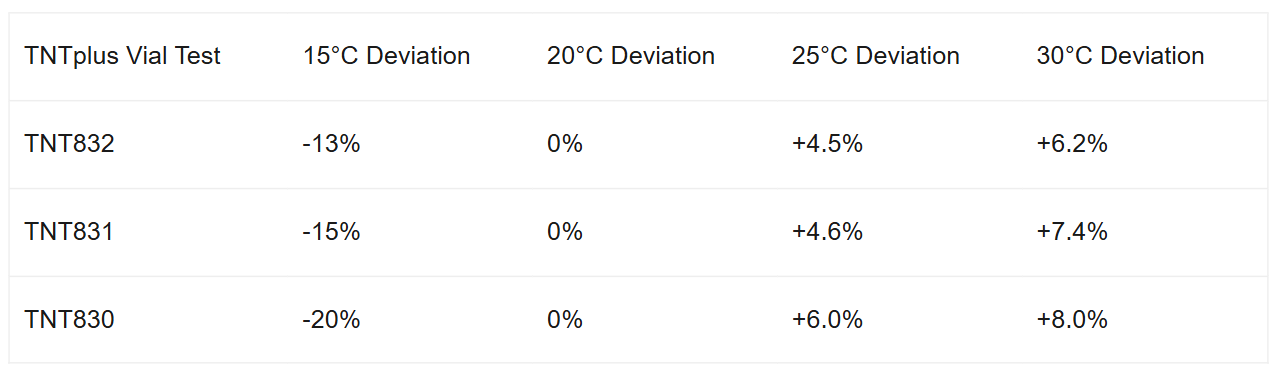
Choose to run these tests as close to 20°C as possible if regulatory compliance or process decisions depend on tight result accuracy. A 20% deviation, as seen with TNT830 at 15°C, is more than enough to turn a compliant result into a reportable exceedance, or vice versa.
如果法規遵循或流程決策依賴數據結果的嚴格準確度,則應盡可能在接近 20°C 的溫度下進行這些測試。例如,TNT830 在 15°C 下測試結果出現 20% 的偏差,就足以將符合法規標準的結果變為需要報告的超標結果,反之亦然。
Best Practices for Temperature Control in Photometric Testing 光度測試中溫度控制的最佳做法
A few consistent habits go a long way toward eliminating temperature bias from your ammonia and other colorimetric testing workflows 建立一些固定的習慣,就能有助於消除氨和其他比色測試工作流程中的溫度偏差 :
- Bring refrigerated samples and reagents to room temperature before analysis. Allow adequate time for equilibration rather than testing straight from cold storage. 分析前,請將冷藏的樣品和試劑恢復至室溫。應留出足夠的平衡時間,切勿直接從冷藏狀態取出進行測試。
- Cool digested samples before reading. For COD and total phosphorus tests, let vials cool to room temperature after digestion before placing them in the photometer. 加熱消解後的樣品冷卻後再進行讀數。對於化學需氧量(COD)和總磷測試,消解後將樣品瓶冷卻至室溫後再放入光度計。
- Maintain a climate-controlled lab environment. Keeping ambient lab temperature within the 59 to 77°F (15 to 25°C) range reduces the risk of seasonal bias, particularly during summer months. 保持實驗室環境溫控。將實驗室環境溫度保持在 59 至 77°F(15 至 25°C)範圍內,可以降低季節性偏差的風險,尤其是在夏季。
- Use a water bath for precise temperature adjustment. A thermostat-controlled water bath set to 20°C offers the most reliable way to bring both samples and reagents to the exact calibration temperature before testing. 使用水浴進行精確的溫度控制。將恆溫水浴設定為 20°C,是確保樣品和試劑在測試前達到精確校正溫度的最可靠方法。
These steps require minimal extra time but can meaningfully improve the accuracy and defensibility of your results, especially in labs supporting regulatory compliance reporting. 這些步驟只需花費極少的額外時間,但可以明顯提高結果的準確度和可辯護性,尤其是在支持法規合規報告的實驗室中。
How Does the DR4900 Spectrophotometer Account for Temperature DR4900 分光光度計的設計如何考慮到溫度影響?
The DR4900 spectrophotometer builds on decades of Hach research into temperature-related measurement bias with a feature designed to remove the guesswork from temperature control: automatic temperature compensation for ammonia testing.
DR4900 分光光度計建立在Hach數十年來對溫度相關測量偏差的研究基礎上,目的在消除溫度控制中猜測的功能:氨測試的自動溫度補償。
Here’s how it works 它的運作方式如下 :
- Infrared vial temperature measurement 紅外線試劑瓶溫度測量 : The DR4900 uses IR technology to automatically measure the temperature of TNTplus vial tests at the moment of analysis. The measured temperature is displayed for all TNTplus vial tests, without requiring the technician to manually record or input a value. DR4900分光光度計採用紅外線技術,可在分析瞬間自動測量TNTplus試管的溫度。所有TNTplus試管的測量溫度均會顯示,無需技術人員手動記錄或輸入數值。
- Out-of-range warnings 溫度超出範圍警告 : Temperature warnings are available for many TNTplus vial tests. If the vial temperature falls outside the method-specific range where temperature could significantly affect the result, the DR4900 flags it so the technician can address the temperature before proceeding. 許多 TNTplus 試劑瓶測試都提供溫度警告功能。如果試劑瓶溫度超出此方法規定的溫度範圍(此溫度可能明顯影響測試結果),DR4900 會發出警告,以便技術人員在繼續操作前處理溫度問題。
- Automatic correction to 20°C: For ammonia TNTplus vial tests, the DR4900 uses the measured vial temperature to apply a correction and report the result as though the test had been run at the 20°C reference temperature. Temperature compensation is specific to the ammonia TNTplus methods and directly addresses the temperature-related deviations seen in the TNT832, TNT830, and TNT831 data above. 自動校正至 20°C:對於氨氣 TNTplus 樣品瓶測試,DR4900分光光度計 會使用測得的樣品瓶溫度進行校正,並將結果報告為如同在 20°C 參考溫度下進行的測試。溫度補償是氨氣 TNTplus 方法特有的,可直接解決上述 TNT832、TNT830 和 TNT831 數據中出現的溫度相關偏差。
This feature is especially valuable for labs juggling high sample volumes, inconsistent ambient conditions, or staff with varying levels of experience, since it removes reliance on manual temperature checks and water bath scheduling for every single sample. 對於需要處理大量樣品、環境條件不穩定或員工操作經驗參差不齊的實驗室來說,此功能尤其有價值,因為它無需對每個樣品進行手動溫度檢查和水浴安排。
Why Temperature Control Matters for Accurate, Defensible Results 為什麼溫度控制對獲得準確、可靠的分析結果很重要
Temperature is one of the simplest variables to control in a water quality lab, yet it remains one of the most common sources of unexplained result variability. Whether you’re running ammonia tests, COD, or total phosphorus, keeping your samples and reagents close to the 20°C calibration standard is a small step that pays off in measurement accuracy.
溫度是水質實驗室中最容易控制的變數之一,但它仍然是導致結果出現不明原因差異的最常見原因之一。無論您是進行氨氮、化學需氧量 (COD) 還是總磷測試,將樣品和試劑的溫度保持在接近 20°C 的校正標準範圍內,都是提高測量精度的一個小步驟。
For labs looking to remove this variable altogether, the DR4900 spectrophotometer’s IR temperature measurement, temperature warnings, and automatic compensation feature offers a built-in safeguard, correcting for temperature bias in real time so your team can focus on the work that matters most: producing reliable data your plant and regulators can trust.
對於希望完全消除此變數的實驗室而言,DR4900 分光光度計的紅外線溫度測量、溫度警告和自動補償功能提供內建的安全保障,可即時校正溫度偏差,進而讓您的團隊能夠專注於最重要的工作:產生您的工廠和法規監管機構可以信賴的可靠數據。
Source : Hach US
#Hach #水質分析 #水質監測 #WaterQuality #WaterAnalysis #水處理